
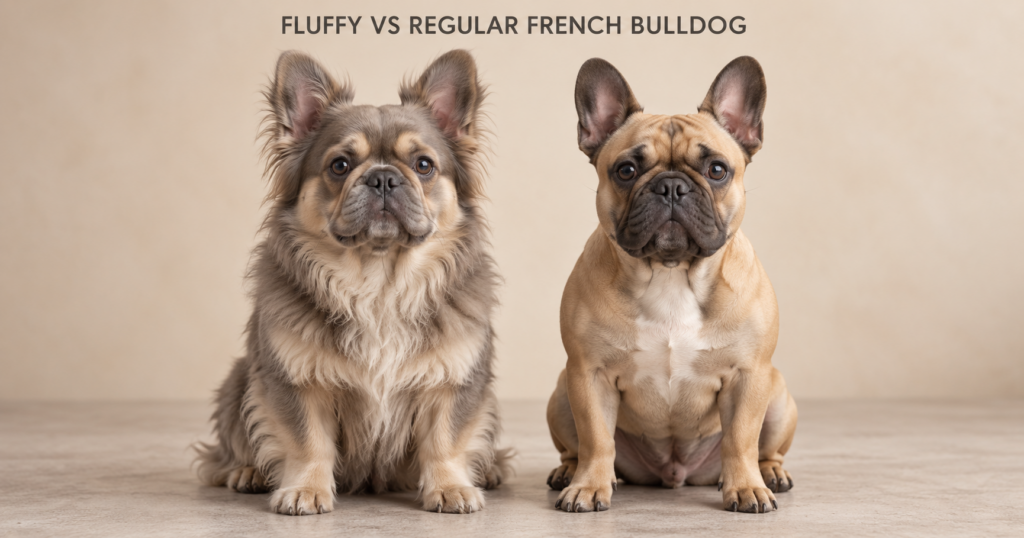
The fluffy French Bulldog vs regular French Bulldog comparison mainly concerns coat length, grooming, availability, price, and show-standard status. A fluffy Frenchie has a longer coat linked to inherited FGF5 variants. A regular Frenchie has the breed’s familiar short, smooth coat. Their basic build, temperament, exercise needs, and breed-related health risks remain broadly similar.
A 2026 genetics study described five established FGF5 long-hair variants and four newly associated variants in dogs. Meanwhile, the French Bull Dog Club of America identifies four core health-screening areas for the breed: hips, eyes, patellas, and heart.
This guide is for families comparing the two coat types before choosing a puppy. It explains genetics, grooming, health, recognition, price, and daily care. It also includes a practical buyer scorecard based on the puppy-selection process used by Fluffy King Kennels.
Quick Comparison
| Feature | Fluffy French Bulldog | Regular French Bulldog |
| Coat | Longer, soft and feathered | Short, smooth and close |
| Main coat genetics | Long-hair FGF5 variants | Short-coat phenotype |
| Grooming | Brushing several times weekly | Usually weekly brushing |
| Tangle risk | Higher around ears and legs | Low |
| Shedding | Varies by dog | Varies by dog |
| Size and build | Typical French Bulldog build | Typical French Bulldog build |
| Temperament | Affectionate, playful and adaptable | Affectionate, playful and adaptable |
| Exercise needs | Short, controlled daily activity | Short, controlled daily activity |
| Health priorities | French Bulldog health screening | French Bulldog health screening |
| AKC conformation standard | Long coat is disqualifying | Short, smooth coat is standard |
| Availability | Less common | More widely available |
| Typical price | Often higher | Usually less than rare fluffy puppies |
The table gives the short answer. However, coat length alone should never decide which puppy joins your family.
What Is a Fluffy French Bulldog?
A fluffy French Bulldog is a French Bulldog with a visibly longer coat caused by inherited hair-length variants. The longer hair usually appears around the ears, chest, neck, back, and legs. People also call these dogs fluffy Frenchies or long-haired French Bulldogs.
A fluffy Frenchie should still display the breed’s familiar physical characteristics. These include a compact body, broad head, upright ears, and short muzzle.
The word “fluffy” describes the coat. It does not create a separate dog breed.
A regular French Bulldog has a short coat that lies close to the body. The official French Bulldog standard describes the traditional coat as brilliant, short, and smooth.
Therefore, the central fluffy French Bulldog vs regular French Bulldog difference is coat phenotype. It is not an entirely different personality or body type.
How Are Their Coats Different?
A fluffy Frenchie has longer hair with more visible texture and feathering. A regular French Bulldog has short, fine hair that follows the body’s outline. The difference becomes most noticeable around the ears, neck, chest, shoulders, and hind legs.
Fluffy Frenchie Coat
A fluffy coat may appear:
- Longer around the ears
- Fuller across the chest
- Feathered behind the legs
- Softer around the neck
- More textured along the back
- Thicker around the tail area
Coat length can vary between individual puppies. Some look lightly feathered, while others appear noticeably fluffy.
Regular Frenchie Coat
A regular French Bulldog usually has:
- Short hair
- A smooth texture
- A close-fitting coat
- Minimal feathering
- Easier visual skin inspection
- Lower tangle risk
Short hair does not mean no grooming. Regular Frenchies still shed and need routine brushing, bathing, nail care, and skin-fold cleaning.
What Causes the Fluffy Coat?
The fluffy coat results from inherited variants affecting the fibroblast growth factor 5, or FGF5, gene. FGF5 helps regulate the hair-growth cycle. Certain variants allow hair to grow longer before the cycle ends.
A 2026 peer-reviewed genetics study explains that long hair in dogs is generally recessive. Researchers identified five established FGF5 long-hair variants. They also reported four additional variants associated with long-haired dogs.
Under a simple recessive model:
- A puppy receiving no long-hair copy will usually have short hair.
- A puppy receiving one copy may carry the trait without appearing fluffy.
- A puppy receiving two relevant copies may express a long-haired coat.
Genetics can become more complex when different variants occur. Therefore, breeders should use an appropriate laboratory test and interpret results carefully.
Can Short-Haired Parents Produce Fluffies?
Yes. Two short-haired French Bulldogs can produce fluffy puppies when both parents carry compatible recessive long-hair variants.
Here is a simplified carrier-to-carrier example:
| Possible puppy result | Expected genetic chance |
| No long-hair copy | 25% |
| One carrier copy | 50% |
| Two long-hair copies | 25% |
These percentages describe the expected probability for each puppy. They do not guarantee an exact litter ratio.
For example, a four-puppy litter will not always contain exactly one fluffy puppy. Each puppy receives its genes independently.
Do Fluffy Frenchies Need More Grooming?
Yes. Fluffy French Bulldogs usually need more coat maintenance because longer hair can collect loose fur, dirt, and moisture. However, their grooming requirements remain manageable with a consistent routine.
Brush a fluffy Frenchie two or three times weekly. Increase brushing during periods of heavier shedding.
Pay close attention to:
- Hair behind the ears
- Chest feathering
- Hair behind the front legs
- Hind-leg feathering
- Tail area
- Facial folds
- Skin beneath the coat
Use a soft slicker brush or suitable pin brush. Work gently to avoid pulling the skin.
A regular French Bulldog usually needs brushing once weekly. However, frequency depends on the individual dog’s coat and shedding pattern.
Do Fluffy French Bulldogs Shed Less?
Not necessarily. Coat length does not reliably predict how much a dog will shed. Both fluffy and regular French Bulldogs can release loose hair throughout the year.
A longer coat may make shed hair more visible. It can also hold loose hairs until brushing removes them.
Diet, skin health, season, hormones, allergies, and grooming can affect shedding. Sudden hair loss, bald patches, redness, or severe itching require veterinary attention.
Simple Grooming Schedule
- Brush the coat two or three times weekly.
- Check behind the ears for small tangles.
- Keep facial folds clean and dry.
- Check paws, nails, and ears weekly.
- Bathe using a dog-safe product when needed.
- Dry the coat and skin folds completely.
- Ask a veterinarian about persistent skin problems.
Never shave a fluffy Frenchie simply to reduce normal shedding. Speak with a veterinarian or qualified groomer before making major coat-care changes.
Do They Have Different Temperaments?
Fluffy and regular French Bulldogs do not have separate breed-specific temperaments. Both can be affectionate, playful, alert, adaptable, and people-focused. Individual temperament depends more on genetics, parental behavior, early socialization, training, and home environment.
The French Bull Dog Club of America describes the expected temperament as affectionate, even, active, alert, and playful.
However, no breeder can promise an identical personality in every puppy. Even littermates can differ in confidence, activity, independence, and social behavior.
Families should consider:
- Confidence around unfamiliar people
- Response to gentle handling
- Interest in play
- Recovery after a new sound
- Comfort around other dogs
- Energy level
- Ability to settle
- Early socialization history
At Fluffy King Kennels, families can review available Fluffy French Bulldog puppies and discuss which puppy may fit their household.
Choose temperament before color or coat. A well-matched puppy usually matters more than a specific appearance.
Are Their Health Risks Different?
A fluffy coat does not prove that a French Bulldog is healthier or less healthy. Both coat types share the breed’s structural and inherited health concerns. Current FGF5 research explains hair length, but it does not make coat length a complete health indicator.
French Bulldogs have short skulls and compact bodies. Therefore, responsible screening and careful physical evaluation remain essential.
Potential areas requiring attention include:
- Breathing and airway function
- Hips and joints
- Kneecaps
- Spine and mobility
- Eyes
- Heart
- Skin and facial folds
- Heat tolerance
- Allergies
A large VetCompass study led by veterinarian Dr. Dan O’Neill found important health differences between French Bulldogs and the wider dog population. The findings support careful selection for healthier physical traits.
The French Bull Dog Club of America health guidance identifies four required CHIC screening areas:
- Hip evaluation
- CAER eye examination
- Patellar evaluation
- Cardiac evaluation
The club also recommends considering respiratory function, tracheal, elbow, cataract, and other relevant testing.
DNA Testing Is Not Enough
A clear DNA panel does not prove that a dog has healthy hips, eyes, breathing, or heart function. DNA testing evaluates specific inherited variants. It cannot replace physical examinations and phenotype-based screening.
A responsible evaluation may include:
- Veterinary physical examination
- Parent health records
- OFA or PennHIP results
- Eye examination
- Patellar evaluation
- Cardiac evaluation
- Airway assessment
- Relevant DNA testing
- Review of the puppy’s movement and structure
This distinction matters when comparing a fluffy French Bulldog vs regular French Bulldog. Coat genetics should never replace comprehensive health information.
Veterinary note: This article provides general education. It does not replace examination, diagnosis, or advice from a licensed veterinarian.
Does the AKC Recognize Fluffy Frenchies?
A long coat does not automatically prove or disprove a dog’s ancestry. Pedigree records and verified parentage determine whether a dog comes from documented French Bulldog lines. However, a long coat does not meet the current AKC French Bulldog conformation standard.
The official standard requires a short, smooth coat. It lists other coat types as a disqualification in conformation competition.
This distinction is important:
- Breed ancestry concerns parentage and pedigree.
- Registration records documented ancestry under registry rules.
- Breed standard describes traits evaluated in conformation shows.
- Conformation eligibility is not the same as suitability as a family companion.
Buyers should ask for clear documentation. They should not assume that appearance alone proves registration, health, or ethical breeding.
Why Do Fluffy Frenchies Cost More?
Fluffy French Bulldogs often cost more because the expressed long-hair trait is less common. Breeding programs may also invest in DNA testing, parent health screening, veterinary care, and careful pairing.
Price can also change based on:
- Pedigree
- Parent health records
- Coat expression
- Color and pattern
- Structure
- Breeding rights
- Location
- Veterinary care
- Socialization
- Transportation
- Breeder support
A higher price does not automatically mean a healthier puppy. Likewise, a lower price does not always represent good value.
Ask what the price includes. Request written details about health checks, vaccinations, contracts, deposits, registration, and post-placement support.
Fluffy King Kennels explains its reservation process through the French Bulldog puppy application. Current availability and pricing should always be confirmed directly.
Which Type Should You Choose?
Choose a fluffy French Bulldog if you love the longer coat and can maintain it consistently. Choose a regular French Bulldog if you prefer the traditional smooth coat and a simpler brushing routine. For either type, prioritize health, temperament, and responsible breeding.
Choose a Fluffy Frenchie If:
- You prefer a longer, textured coat.
- You can brush several times weekly.
- You understand the coat’s genetic basis.
- You accept limited conformation eligibility.
- You are comfortable with potentially higher pricing.
- You have time to check the coat and skin regularly.
Choose a Regular Frenchie If:
- You prefer the traditional short coat.
- You want a simpler grooming routine.
- You want a coat matching the conformation standard.
- You prefer broader availability.
- You do not want feathering or tangle management.
Fluffy Frenchie Buyer Scorecard
Score each item from zero to two.
- 0: Not suitable or unavailable
- 1: Partly suitable or unclear
- 2: Suitable and documented
| Decision factor | Score |
| Household accepts regular grooming | /2 |
| Breeder provides parent health records | /2 |
| Puppy’s temperament fits the household | /2 |
| Family understands Frenchie heat sensitivity | /2 |
| Veterinary costs fit the budget | /2 |
| Coat preference is practical, not impulsive | /2 |
| Contract and deposit terms are clear | /2 |
| Ongoing breeder support is available | /2 |
| Total | /16 |
A score below 12 suggests that you need more information or preparation. This scorecard is a planning tool, not a health guarantee.
Questions to Ask a Breeder
Ask direct questions before paying a deposit. A responsible breeder should answer clearly and provide supporting records where appropriate.
- What health testing did both parents complete?
- Can I review the recorded results?
- Which FGF5 variants were tested?
- Does the puppy have verified pedigree documentation?
- Has a veterinarian examined the puppy?
- What vaccinations has the puppy received?
- How was the puppy socialized?
- What signs of breathing difficulty should I watch for?
- What does the health guarantee cover?
- Are deposit and refund terms written clearly?
- What support is available after the puppy goes home?
- Can you help match temperament to my household?
You can contact Fluffy King Kennels to ask about puppies, health information, pickup, delivery, and ongoing support.
Austin Ownership Considerations
French Bulldogs in Austin need careful warm-weather management. Both fluffy and regular Frenchies can struggle during hot or humid conditions because of their short muzzles. A longer coat does not remove or create the breed’s core airway risk.
Austin families should:
- Schedule walks during cooler hours.
- Avoid hard exercise during extreme heat.
- Provide constant access to fresh water.
- Use indoor air conditioning when needed.
- Watch for noisy or labored breathing.
- Never leave a Frenchie inside a parked vehicle.
- Ask a veterinarian about safe activity limits.
Keep outings short when temperatures rise. Stop activity if the dog appears distressed, weak, confused, or unusually noisy while breathing.
Fluffy King Kennels is based in Austin, Texas. Its puppy-placement process includes health details, veterinary preparation, early socialization, and support for new owners.
Frequently Asked Questions
Question: What is the difference between a fluffy and regular French Bulldog?
Answer:The main difference is coat length. A fluffy French Bulldog has longer hair associated with inherited FGF5 variants. A regular French Bulldog has a short, smooth coat. Both are French Bulldogs and can share similar size, temperament, exercise needs, and breed-related health concerns.
Question: Are fluffy French Bulldogs purebred?
Answer:A fluffy coat alone cannot prove whether a French Bulldog is purebred or mixed. Verified parentage and pedigree documentation provide that evidence. Long-haired French Bulldogs can come from documented French Bulldog lines, although their coats do not meet the current AKC conformation standard.
Question: Why are some French Bulldogs fluffy?
Answer:Some French Bulldogs are fluffy because they inherit compatible long-hair variants affecting the FGF5 gene. These variants change the hair-growth cycle and create a longer coat. Short-haired parents can produce fluffy puppies when both parents carry relevant recessive variants.
Question: Are fluffy French Bulldogs healthier?
Answer:Fluffy French Bulldogs are not automatically healthier or less healthy than regular French Bulldogs. The FGF5 variants primarily explain coat length. Health depends on airway structure, joint condition, heart, eyes, spine, skin, genetics, breeding decisions, veterinary care, and lifestyle.
Question: Do fluffy French Bulldogs shed?
Answer:Yes. Fluffy French Bulldogs can shed throughout the year. Their longer hair may hold loose fur until brushing removes it. Shedding varies by individual dog and may change with season, diet, skin health, hormones, allergies, and grooming.
Question: Do fluffy French Bulldogs need haircuts?
Answer:Most fluffy French Bulldogs do not need regular full haircuts. They benefit from brushing, bathing, nail care, ear checks, and careful skin-fold cleaning. Light sanitary trimming may help some dogs, but owners should consult a qualified groomer or veterinarian before cutting the coat.
Question: Are fluffy French Bulldogs recognized by the AKC?
Answer:A documented French Bulldog may be eligible for registration under applicable registry rules. However, the current AKC conformation standard requires a short, smooth coat. A long coat is a conformation disqualification. Registration and conformation eligibility are different issues.
Question: Which French Bulldog is better for families?
Answer: Neither coat type is automatically better for every family. Both can become affectionate family companions. Choose based on health documentation, temperament, household compatibility, grooming commitment, budget, and breeder transparency rather than coat length alone.
Final Summary
The fluffy French Bulldog vs regular French Bulldog decision begins with coat preference but should not end there. Fluffy Frenchies have longer FGF5-related coats and need more brushing. Regular Frenchies have short, smooth coats and meet the traditional coat standard.
Their typical temperament, body type, exercise needs, and major health priorities remain similar. Neither coat guarantees better health, lower shedding, or a better personality.
Choose the puppy with suitable temperament, documented health preparation, and responsible breeder support. If the longer coat fits your lifestyle, explore the Fluffy King Kennels breeding program and current puppies in Austin, Texas.